
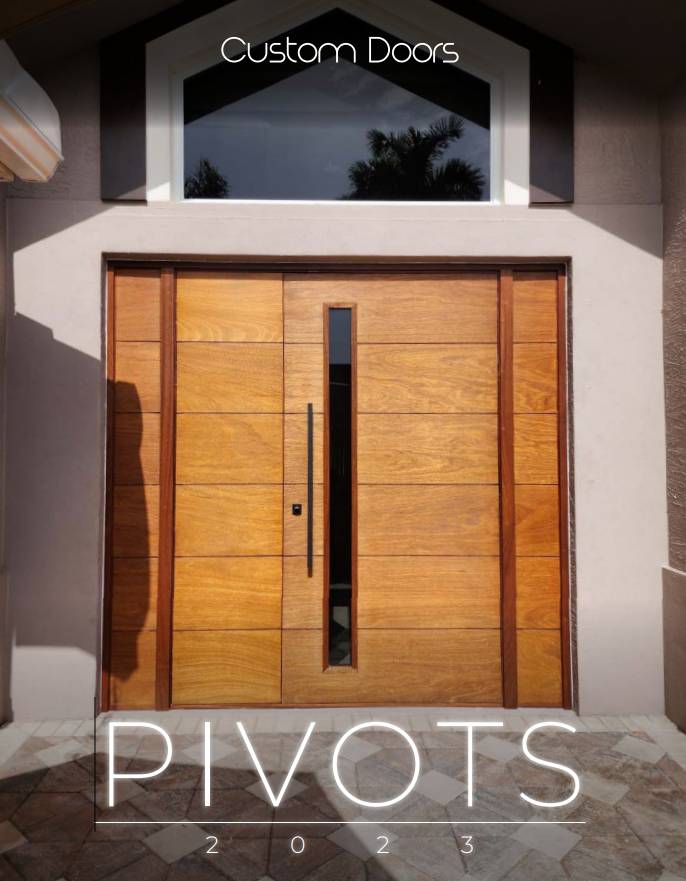
Pivot doors get most of the architectural press right now — the oversized panels, the cinematic rotation, the way light moves around a pivot as it opens. But swing doors are not obsolete. They are still the right choice for a lot of Florida projects, and the decision between the two is more nuanced than “pivots look better.” This article walks through the actual functional differences, where each one wins, and what changes when you add Florida’s hurricane code to the picture.
How they differ mechanically
A swing door rotates on hinges set into one side of the frame. The hinges carry the full weight of the door panel and the cyclical loads of opening and closing. Most residential swing doors are limited to about 80 to 100 pounds per panel before the hinges and frame become impractical.
A pivot door rotates around a vertical axis set inside the door — typically offset from the hinge edge, so the panel pivots like a revolving door rather than swinging from one side. The pivot mechanism is mounted to the floor and the head jamb, transferring the door’s weight to the structure rather than to the side jamb. That structural difference is why pivots can carry panels in the 300–600+ pound range that swing doors cannot.
Where pivots win
- Oversized panels. If the panel is taller than 9 feet or wider than 4 feet, a pivot is structurally far easier than a swing. Portasui’s hurricane-impact pivot doors can be specified up to 50 inches wide × 147¾ inches frame height under FL#28370.
- Architectural statement. The proportions a pivot allows — a single solid mahogany panel as a 10-foot focal entry — are not possible with a hinged swing.
- Smooth operation under weight. A heavy pivot opens with less effort than the equivalent-weight swing door, because the pivot axis is closer to the center of mass.
- Modern aesthetic. Pivots photograph well and align with contemporary architecture — they read as a designed object, not a default door.
Where swing doors win
- Weatherstripping and seal. Swing doors are easier to seal tightly. The full perimeter of a swing closes against the jamb stop, where a pivot has a thin axis line that requires more careful detailing.
- Lower cost in many configurations. Depending on the specific design, a comparable swing door is typically 10–15 percent cheaper than a pivot of the same size and material — fewer custom mechanisms, simpler hardware. The cost gap narrows on oversized panels and widens on standard sizes.
- Easier replacement. If you ever need to replace the door panel, a swing comes out by unscrewing the hinges. A pivot requires resetting the floor and head pivots.
- Smaller openings. If the door is less than ~36 inches wide and 8 feet tall, the pivot mechanism is overkill. A swing is the right answer.
- Pair / double-door configurations. Two-leaf pair doors are almost always swing — pivot pair doors exist but are rare and expensive.
What changes when you add Florida hurricane code
In HVHZ counties (Miami-Dade and Broward), every exterior opening has to either resist windborne debris on its own or be shuttered. That means whichever door you choose — pivot or swing — needs a Florida Product Approval covering its size, configuration, and Design Pressure rating. Portasui documents its FL#28370 (pivot) and FL#16326 (classical/swing) approvals on the Florida Hurricane-Impact Doors page.
Two specific constraints to know:
- Hurricane Pivot Doors CAN include impact-resistant glass — provided the glass configuration is part of the approved and tested door system under the Florida Product Approval. Glass cannot be added or modified after the fact; it must match the tested configuration. This gives you natural-light options inside the pivot panel itself, not just in sidelites or transom.
- Both pivot and swing doors can be specified with impact-rated glass in the panel as part of their approved configuration — useful when a homeowner wants natural light in the entry. The difference is in how easily different glass patterns can be customized later; swing doors generally allow more after-the-fact flexibility, while pivots require the glass spec to be locked in at the design stage.
Both pivot and swing can carry the same Design Pressure rating (Portasui’s FL#28370 pivot and FL#16326 swing approvals are both at +65/-65 PSF). The structural performance is equivalent. The choice is about aesthetics, glass strategy, and budget — not safety.
Side-by-side: a working comparison
Same Miami new build, same 8-foot opening, same Honduran mahogany, same hurricane rating — what changes between pivot and swing:
- Pivot — single panel, no centerline, smooth horizontal grain, statement scale. Higher cost. Glass-in-panel possible only when locked in at the design stage as part of the approved configuration. Floor pivot requires careful detailing in the threshold.
- Swing — single or pair panel, traditional hardware, more flexibility for impact glass in the panel, easier to weather-seal. Lower cost. Traditional Mediterranean or classical designs read better as swing than as pivot. See Portasui’s modern mahogany doors for swing configurations under FL#16326.
How to decide
Three quick questions that usually settle it:
- Is the entry meant to be a focal architectural element, or is it a functional doorway in a wall? Focal element points pivot. Functional doorway points swing.
- Do you want glass in the door panel itself? Both pivot and swing can do this, but it has to be specified at the design stage as part of the approved configuration — swing doors generally offer more after-the-fact flexibility.
- Is the panel oversized — taller than 9 feet or wider than 4 feet? Oversized strongly points to pivot.
If two of three answers point to one option, that is almost always the right choice.
The Portasui catalog has both
Portasui builds hurricane-rated mahogany doors in both configurations at our Miami location, with the same Honduran mahogany and the same old-world mortise-and-tenon joinery we describe on our About page. The Hurricane-Impact Pivot Doors category lists 86 designs under FL#28370. The Modern Doors category and the classical/swing line cover the swing configurations under FL#16326. The right starting point is a sketch or photo of your project; request a quote and we will come back with a recommendation that fits your specific opening, climate exposure, and budget.
